How To Answer PSLE Science Exam Questions With Confidence

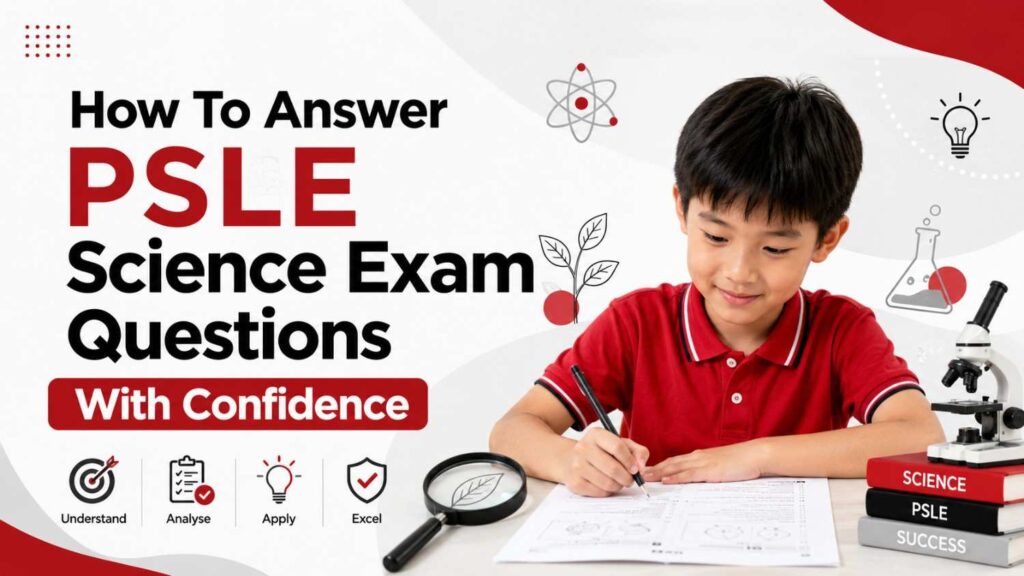
Boy in a red polo shirt writing answers on a Science exam paper at a desk with a microscope, magnifying glass, and stacked PSLE Science books

Share This Post

Many Primary 5 and Primary 6 students understand Science concepts during lessons, but still lose marks when answering exam questions. This often happens because their answers are too vague, too short, or not clearly linked to the question.

For parents, this can be frustrating. Your child may know the topic, but the marks do not always reflect their effort. This guide will help students learn how to answer PSLE Science exam questions more clearly, especially open-ended questions that require explanation and application.

As a leading tuition centre in Singapore, we believe that Science exam success is not just about memorising facts. Students need to understand the question, identify the concept, use evidence, and explain their answers in a structured way.

Why Students Lose Marks In PSLE Science Questions

PSLE Science questions often test more than recall. Students are expected to apply concepts to experiments, diagrams, tables and real-life situations. This means that knowing the topic is only the first step.

Many students lose marks because they:

  • Give one-word answers without explanation
  • Use Science keywords incorrectly
  • Do not answer the exact question asked
  • Miss important clues in the diagram or table
  • Write too much without making a clear point
  • Memorise model answers without understanding them

To improve, students need a simple and repeatable method for answering Science questions.

Step 1: Read The Question Carefully

Before writing, students should slow down and identify what the question is asking. Many mistakes happen because students rush into the answer too quickly.

Look Out For Command Words

Command words tell students how to respond. For example:

  • State means give a direct answer
  • Explain means give a reason using Science concepts
  • Describe means explain what is happening
  • Compare means show similarities or differences
  • Suggest means give a possible answer based on the information given
  • Conclude means make a decision based on evidence

A useful habit is to underline the command word before answering. This helps students avoid writing an answer that does not match the question.

Step 2: Identify The Science Concept Being Tested

Primary school student writing notes while holding a worksheet with diagrams, next to a microscope and science-themed icons

Every question is linked to a Science concept. Before answering, students should ask themselves, “What topic is this question testing?”

Common PSLE Science topics include:

  • Heat transfer
  • Forces
  • Electrical systems
  • Plant parts and functions
  • Human body systems
  • Life cycles
  • Adaptations
  • Water cycle
  • Matter and changes in state

Once the concept is clear, it becomes easier to choose the right keywords and explanation.

Step 3: Use Evidence From The Question

Good Science answers should not sound like memorised sentences. They should be linked to the question.

Evidence can come from:

  • A diagram
  • A graph
  • A table
  • An experiment setup
  • A comparison between two objects
  • An observation stated in the question

For example, if a question shows that Plant A grew taller than Plant B, students should mention that observation in their answer. They should then connect it to the Science concept, such as light, water, air, or nutrients.

Step 4: Structure Open-Ended Answers Clearly

Open-ended questions are where many students lose marks. A clear answer structure can help.

Students can use this simple method:

Answer

Give the direct answer first.

Evidence

Use information from the question, diagram, table or experiment.

Science Link

Explain the Science concept that supports the answer.

For example:

“The ice cube melts faster on the metal plate because metal is a better conductor of heat. Heat from the surroundings is transferred through the metal plate to the ice cube more quickly, causing it to gain heat and melt faster.”

This answer works because it gives a direct comparison, uses the concept of heat transfer, and explains the reason clearly.

Parents who want more structured exam preparation can explore our trusted PSLE tuition for support in English, Maths and Science.

Step 5: Use Accurate PSLE Science Keywords

Science keywords help students show understanding, but they must be used correctly. Adding keywords without explanation will not always earn marks.

Useful Science keywords include:

  • Heat gain
  • Heat loss
  • Conductor
  • Insulator
  • Evaporation
  • Condensation
  • Friction
  • Force
  • Energy conversion
  • Germination
  • Adaptation
  • Reproduction

Students should not memorise keywords blindly. Instead, they should learn what each keyword means and practise using it in different question types.

Step 6: Check The Marks Given

The number of marks gives a clue about how much detail is needed.

As a general guide:

  • 1 mark usually needs one clear point
  • 2 marks usually need an answer and a reason
  • 3 marks may need an answer, evidence and explanation

If a question is worth 2 or 3 marks, students should avoid giving a short answer unless the question clearly asks for only one point.

Step 7: Practise Corrections, Not Just Papers

Doing many practice papers can help, but only if students learn from their mistakes. If a child keeps repeating the same type of error, more papers alone may not solve the problem.

How Parents Can Help At Home

Parents can support their child by asking:

  • What is the question asking?
  • What Science concept is being tested?
  • Which clue from the question supports your answer?
  • Did you explain your answer clearly?
  • Can you improve this answer using a Science keyword?

Students can also keep a correction notebook. Instead of only writing the right answer, they should write why their original answer lost marks. This helps them avoid the same mistake in future exams.

When Should Your Child Get Extra Help For PSLE Science?

Your child may need extra support if they:

  • Understand lessons but still lose marks in open-ended questions
  • Struggle to explain answers in complete sentences
  • Feel unsure when questions look unfamiliar
  • Use Science keywords incorrectly
  • Score inconsistently across practice papers
  • Spend too much time on Science revision without clear improvement

With the right guidance, students can learn how to break down questions and answer with greater confidence.

Conclusion

Boy writing in an open notebook beside molecular models, a microscope, and a flask of red liquid, exploring Science concepts

Learning how to answer PSLE Science exam questions takes practice, patience and the right technique. Students should focus on understanding the question, identifying the concept, using evidence and explaining their answers clearly.

A strong Science answer is not always the longest answer. It is the answer that is accurate, relevant and well explained.

If your child needs support with PSLE Science exam preparation, contact us today to find out how Stepping Stones can help.

FAQs

Answer the question directly, use evidence from the question, then explain the Science concept clearly. Avoid vague answers and make sure your response matches the marks given.

Your child may understand the topic, but may not be explaining the answer clearly. Many students lose marks because they do not link their answer to the question, diagram or experiment.

The best way is to review mistakes, rewrite weak answers, learn important Science keywords and practise answering with a clear structure.

Your child should use keywords only when they fit the question. The keyword must be connected to the observation, evidence or concept being tested.

No. PSLE Science requires students to understand concepts and apply them to different situations. Memorising answers without understanding can make it harder to answer unfamiliar questions.

More To Explore

Enroll Now !!!

drop us a line and keep in touch

Tutors at Stepping Stones Learning Centre